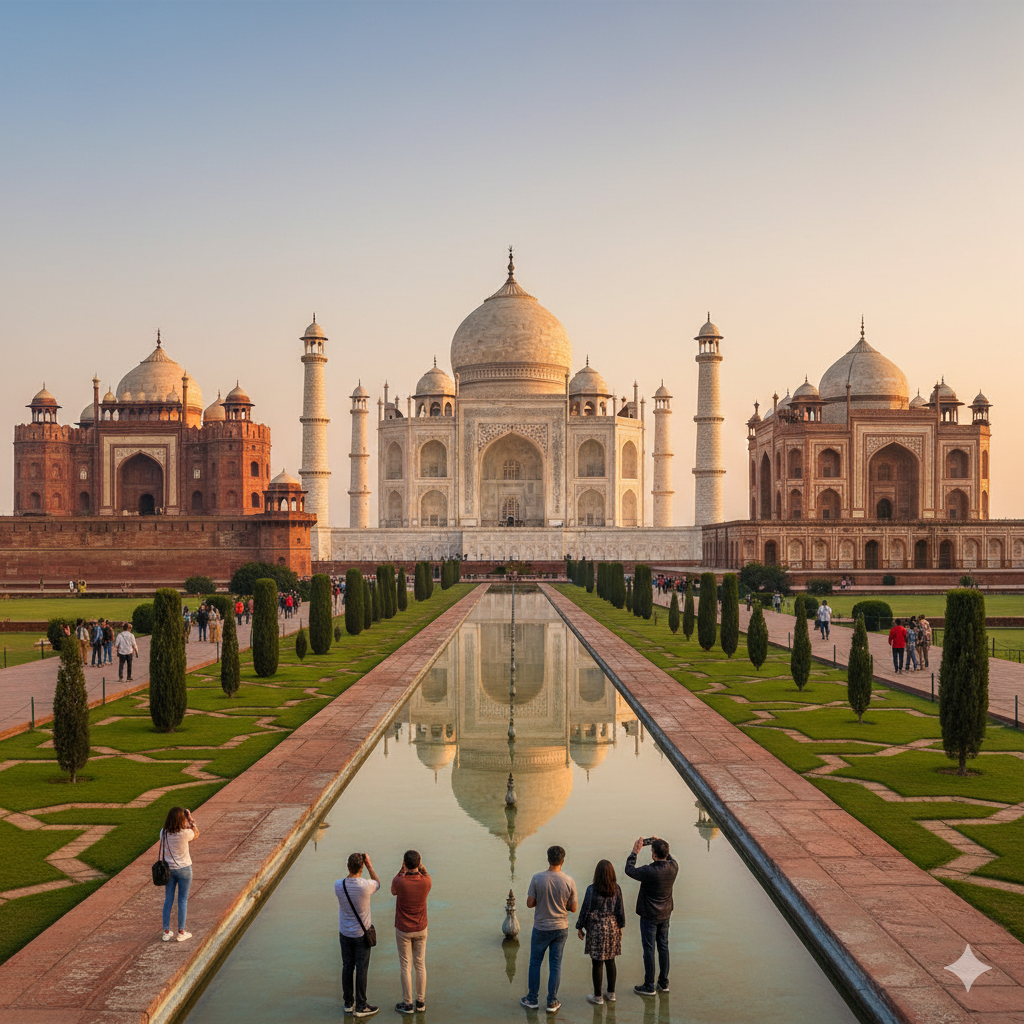
Agra holds a unique place in India’s famed Golden Triangle, captivating millions of travelers each year with its incredible history and architecture. It is, undeniably, the home of the world’s most beautiful monument—the Taj Mahal.
However, many travelers experience a city of strong contrasts. While Agra hosts breathtaking, world-class historical sights, it is also a bustling, energetic urban center that can feel chaotic to first-time visitors. The good news is that you absolutely do not need multiple days to appreciate its core treasures.
With careful planning, it is completely possible to conquer the crowds and the city’s complex rhythm to see all the must-visit places in Agra in a single, well-organized day. Roame Roots brings you this detailed guide to help you make the most of your short trip and experience Agra like a local.
Whether you are arriving from Delhi by car or train, or spending just one night in the area, a single day is enough to immerse yourself in the grandeur of the Mughal Empire. The experience of seeing the Taj Mahal alone is worth the trip, but as you will discover, Agra offers much more than just its iconic mausoleum.
Your One-Day Agra Strategy
To see Agra’s top sights in one day, the key is starting early and knowing how to navigate the city efficiently. Roame Roots recommends the following plan to cover all the highlights without feeling rushed.
1. The Best Time to Visit
The best months to visit Agra are between October and March. The weather is cool and pleasant, making the long hours of sightseeing much easier. Avoid the summer months (April to June) when the heat can be intense.
2. Getting Around
Navigating Agra is straightforward. While you can hire a dedicated car for the day, a popular and cost-effective method is using local transport. Auto-rickshaws (tuk-tuks) are readily available outside all major tourist spots and hotels. It is often recommended to hire a tuk-tuk driver for the entire day. Negotiate a fixed price upfront for a full-day itinerary covering all the main sites listed below. This saves time and avoids negotiating for every single ride.
3. Timing is Everything: The Sunrise Rule
If you want to beat the majority of the crowds and see the Taj Mahal at its most magical, you must aim for sunrise. This requires waking up early, but the tranquility and the soft, glowing colors are an incomparable reward. All major attractions are close enough to be connected easily by road, allowing for a smooth flow from one stop to the next.
The Ultimate One-Day Agra Itinerary
Stop 1: The Taj Mahal (The Sunrise Spectacle)
The Taj Mahal is not just a building; it is a symbol of enduring love and a UNESCO World Heritage site that has captured imaginations for centuries. Its beauty is truly breathtaking, and starting your day here with a Same Day Taj Mahal Sunrise Tour is essential.
History and Legend
The monument was built by the Mughal Emperor Shah Jahan for his beloved wife, Mumtaz Mahal, who passed away in 1631 while giving birth to their 14th child. Her final request was for a grand mausoleum in Agra. The construction lasted over two decades and involved a massive workforce of 20,000 men. This grand effort, financed by emptying the royal treasury, resulted in what is often called the most beautiful mausoleum in the world.
Why Sunrise is Essential
The Taj Mahal opens at 6:00 AM. Arriving just before the gates open allows you to witness the white marble transition from a pale pink hue in the early morning light to a brilliant, dazzling white as the sun climbs higher. Not only is the light perfect for photography, but the complex is significantly less crowded than at midday.
Architectural Detail: The Art of Pietra Dura
While the size and symmetry of the Taj Mahal are impressive, the details are equally important. The entire structure is made of white marble inlaid with thousands of semi-precious colored stones—a technique known as pietra dura. This detailed stone inlay forms intricate floral patterns and calligraphy across the entire exterior and interior.
Inside the Tomb
As you walk through the gardens, known as the charbagh (four gardens), you will find plenty of space for people to spread out. However, expect a queue to enter the central tomb chamber. Inside, you will see the cenotaphs (false tombs) of Mumtaz Mahal and Shah Jahan. The actual tombs are located in a quieter chamber at a lower level.
Insider Tip for the Perfect View:
While sunrise offers the best atmosphere inside the complex, consider returning to the banks of the Yamuna River at sunset. From locations like the Mehtab Bagh, you can get stunning, crowd-free views of the Taj Mahal glowing warmly against the evening sky.
Stop 2: Agra Fort (A Walled City of Power)
Next on your itinerary, after the ethereal beauty of the Taj Mahal, is a visit to the seat of Mughal power.
Located just 2.5 kilometers from the Taj Mahal, the Agra Fort offers a stark, impressive contrast. It is a massive walled city made primarily of red sandstone, built by Emperor Akbar starting in 1565. Before the capital moved to Delhi, this fort served as the main residence of the Mughal emperors.
A Citadel of History
If you have visited the Red Fort in Delhi, you will notice many similarities, as both were designed to function as walled cities that contained courts, mosques, palaces, and administrative centers. The Agra Fort was initially built as a military structure to protect the Mughal capital.
Over time, it evolved from a military bastion to a lavish palace complex. Shah Jahan, who built the Taj Mahal, also made significant additions here, constructing beautiful white marble structures like the Moti Masjid (Pearl Mosque).
Key Areas to Explore
- Jahangiri Mahal: A large palace combining Hindu and Central Asian architectural styles.
- Diwan-i-Am (Hall of Public Audience): Where the emperor would listen to the petitions of the general public.
- Musamman Burj: Perhaps the most poignant spot. This octagonal tower is where Shah Jahan was imprisoned by his son, Aurangzeb, after a bloody coup in 1658. From this tower, the aged Emperor spent the last years of his life gazing across the Yamuna River at the Taj Mahal, the eternal monument to his late wife.
Many visitors agree that the sheer scale, historical depth, and architectural complexity make the Agra Fort one of the most exciting historical places in India. It is a must-see stop on your one-day tour.
Stop 3: The “Baby Taj” – Tomb of Itimad Ud Daulah
After soaking in the history of the massive Agra Fort, take a short, peaceful break to appreciate a masterpiece of intricate design.
Often lovingly called the “Baby Taj,” the Tomb of Itimad Ud Daulah is, in fact, slightly older than its famous counterpart and is often credited as the inspiration for the latter’s design. This monument represents one of the first structures in India to be constructed primarily of marble and feature the delicate pietra dura inlay technique.
A Woman’s Tribute
The mausoleum was built in the early 17th century by Nur Jahan, the wife of Emperor Jahangir, for her father, Mirza Ghiyas Beg. Her father was a Persian nobleman who had risen to become a high official in the Mughal court, earning the title Itimad-ud-Daulah, or “Pillar of the State.”
The Beauty is in the Details
While the Taj Mahal impresses visitors with its grand scale, the Baby Taj captivates with its exquisite details. The structure is smaller and more intimate, surrounded by quiet gardens and lacking the heavy crowds of the main attraction. Here, the focus is on the masterful pietra dura work. Instead of large patterns, you find incredibly fine floral designs, images of wine vases, and geometric shapes, showcasing the artistry that would later reach its peak in the Taj Mahal.
This tranquil spot is a favorite among travelers for its quiet atmosphere and stunning craftsmanship, making it a perfect mid-day stop.
Stop 4: Jama Masjid (The Grand Mosque)
As the afternoon progresses, take a quick detour to appreciate the city’s spiritual architecture.
Located near the Agra Fort railway station, the Jama Masjid (Great Mosque or Friday Mosque) is another magnificent architectural contribution by Shah Jahan. Like the mosques he commissioned in Delhi and the nearby Fatehpur Sikri, it is constructed mainly from contrasting red sandstone and white marble.
Completed in 1648, the Jama Masjid of Agra is one of the largest mosques in India. It was built to demonstrate the power, wealth, and spiritual commitment of the Mughal Empire.
The mosque features a vast courtyard surrounded by a cloistered arcade, complete with impressive domes and minarets. It has three large entrance gates decorated with intricate calligraphy and designs. Although you may not spend as much time here as at the forts, it is a key piece of Agra’s historical puzzle and a stunning sight to behold.
Stop 5: Sadar Bazaar (Evening Activity and Dinner)
Finally, to complete your day of historical immersion, venture out into the bustling, modern city life.
If you have some time left before heading back to your hotel or train station, a visit to Sadar Bazaar is highly recommended. This market area offers a less tourist-focused view of Agra and is a fantastic place to do some shopping.
While not as overwhelming or colorful as the huge bazaars of Delhi or Jaipur, Sadar Bazaar is where you can find genuine local crafts, leather goods, and souvenirs, especially those featuring marble inlay work inspired by the Taj Mahal. It is a great spot to experience the city’s energy.
The Dinner Finale:
For dinner, you must try some of the local cuisine. A popular local favorite is Mamma Franky’s House, known for serving some of the best North Indian food, especially the flavorful chicken kebabs and naan bread, providing a perfect, authentic end to your long day of exploration.
If You Have More Time: Side Trips from Agra
If you decide to extend your stay to two days, or if you plan to travel through the Agra region, two nearby sites are absolutely worth the extra effort.
Sikandra: Akbar’s Tomb
Located only about 10 kilometers away from Agra, Sikandra is where you will find the impressive tomb of Akbar the Great. Akbar, the grandfather of Shah Jahan, began the construction of his own mausoleum, which blends Hindu, Islamic, and Jain architectural styles. Although it is not as large as the Taj Mahal, the structure is incredibly beautiful, rich with elaborate, colorful decorations and set in a large, peaceful garden. It offers a wonderful insight into the Mughal Empire’s earliest building styles.
Fatehpur Sikri: The Ghost City
About an hour’s drive from Agra, Fatehpur Sikri is a fascinating UNESCO World Heritage site. This city was built by Akbar in the late 16th century and served as the Mughal capital for a brief 14-year period before being completely abandoned, likely due to a lack of water.
This perfectly preserved “ghost city” is a must-see for its red sandstone palaces, mosques, and courtyards, including the stunning Buland Darwaza (Gate of Magnificence) and the Panch Mahal. Many travelers find the historical quietness and well-maintained architecture of Fatehpur Sikri to be one of the highlights of the Golden Triangle journey.
Agra is truly a destination that rewards the prepared traveler. By following this fast-paced, carefully timed itinerary, you can easily cover the city’s essential highlights and leave with a complete understanding of its historical, architectural, and cultural importance. The chaos might be present, but the sheer, enduring beauty of these monuments will always shine through.
Plan your trip today and prepare to be enchanted by the City of Love.